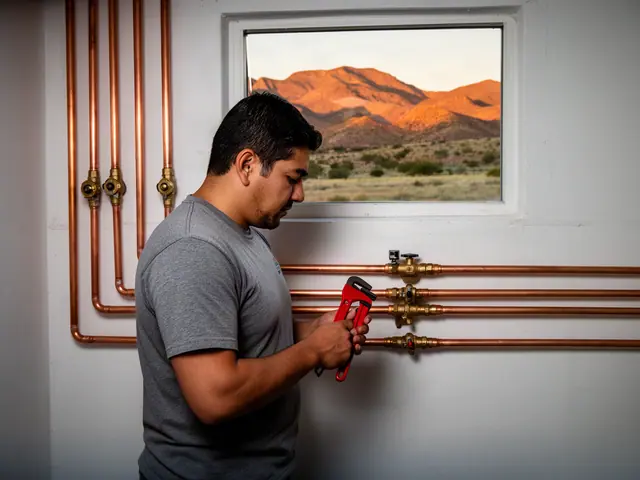
A Cochise County, AZ HVAC firm usually carries parts and payroll through its busiest weeks with a business line of credit, drawn when condensers and parts are ordered and technicians are added and repaid as jobs are paid. Vans and tools go on equipment loans, so the line stays free for the swing.
An article from Rosepine Lenders in Sierra Vista, Arizona on how HVAC and plumbing contractors fund parts, vans and payroll through their busiest weeks, with Cochise County contractor counts, an invented ten-week example and a checklist.
HVAC Contractor Financing for Condensers and Parts Stock
Condensers, air handlers, heat pumps, coils, capacitors, contactors and refrigerant are bought before the jobs that use them, and a firm that waits to order risks losing the job to one that has the unit on the shelf. HVAC contractor financing for that stock is short: draws on a line of credit, or an inventory loan for a large order, repaid as installs are paid.
Plumbing, heating and air-conditioning contractors had 44 employer establishments in Cochise County, AZ in 2023, with 248 paid employees and about $10.8 million in annual payroll, and 25 of them had fewer than five employees (County Business Patterns). A further 49 such contractors worked with no payroll at all in 2024, according to Nonemployer Statistics, which counts them separately.
Equipment units are large single items with serial numbers, which suits inventory financing secured by the stock.
Work Van Financing for a Cochise County, AZ HVAC Crew
A work van is where an HVAC technician earns: it carries the tools, gauges, recovery machine, ladders and parts for a day of calls. Work van financing for a Cochise County, AZ crew is an equipment loan on the van and its upfit, with the van as security.
Put the van, shelving, ladder rack and any inverter on one invoice where possible, so the whole package can be financed together. Equipment financing explains how the van secures its loan.
Service Truck Financing Versus Leasing for a Plumbing Shop
A plumbing shop choosing between financing and leasing a service truck is choosing between ownership and use. A loan buys the truck: the shop builds equity and keeps it after the last payment. A lease pays for use over a term, often with mileage limits and a choice at the end to return, renew or buy.
Compare the two on the total paid over the same years, including the lease's end-of-term purchase price if the shop expects to keep the truck. An upfitted truck may carry return conditions at lease end, so read them before comparing.
Ask about mileage limits, wear charges and what happens to the upfit if a leased truck goes back.
Tax treatment can differ between a loan and a lease as well, since one records an owned asset and the other a rental expense. Ask the firm's accountant how each would show on its returns before deciding; that question belongs with a tax professional rather than a funding partner.
Payroll in the Busiest Weeks: Credit Line or Short Loan?
In a firm's busiest weeks, technicians work overtime and added hires start, payroll grows, and payments for installs arrive after the work is done. The question is whether to carry that payroll with a credit line or a short loan.
A line of credit charges interest only on what is drawn and only while it is drawn, and it can be used again next year. A short working capital loan fixes the amount and schedule, which suits a one-time surge but carries interest for its whole term even after the rush ends. For a pattern that repeats each year, a line usually fits better.
An Invented Ten-Week Rush With Two Techs Added
Illustration only, invented figures: a firm stocks $26,000 in units and parts and adds 2 technicians at $1,150 a week each for 10 weeks, $23,000 in added payroll (our arithmetic). The peak need is $49,000.
Drawn on a line at an invented annual rate of 12%, if the full $49,000 were outstanding for an average of 6 weeks, interest would be about $677 (our arithmetic, simple daily interest). The same amount as a 6-month loan at an invented 13% carries about $1,875 in interest (our arithmetic).
In this invented case the line costs about $1,198 less because it is repaid as installs are paid. Fees, rates and terms in real offers will differ; the interest calculator checks the loan side.
An HVAC Owner Checklist Before the Rush
- List the units and parts to stock and when each will be used.
- Write the payroll plan for added technicians, week by week.
- Note when installs are paid: on completion, net terms or through a contractor.
- Get van and tool quotes separately from the parts order.
- Gather bank statements, tax returns and current debts.
- Ask for the line before the rush, not during it.
The HVAC business loans page covers vans, tools and line pricing.
By Rosepine Lenders · Updated